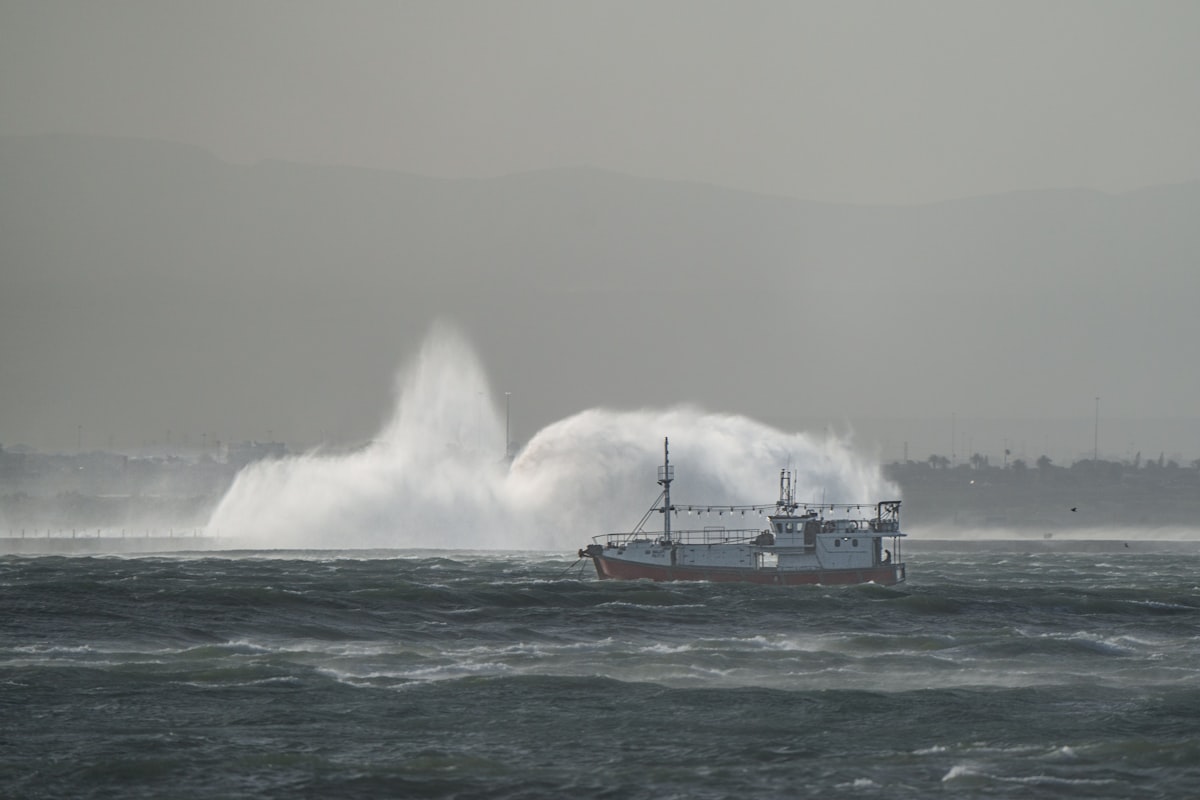
Starlink in Bad Weather: What Happens to the Signal During Storms, Rain and Heavy Seas
This is the question every captain asks before buying: does Starlink actually work when I need it most? Because when conditions are fair and the sea is flat, almost any system works. The real test is the gale, the driving rain on the bow, 35 knots of wind and 4-metre seas.
This guide answers with technical data, not marketing copy.
The Physics of Rain and Satellite Signal
Starlink operates in Ku-band (approximately 12-18 GHz). This frequency band is more sensitive to rainfall than the lower frequencies used by some older VSAT systems, but it also enables more compact antennas and far lower latency than GEO systems in C-band.
How rain attenuates Ku-band signal
Rain absorbs and scatters microwave signals. Attenuation depends on:
- Rainfall intensity (mm/hour): light rain (2 mm/h) → less than 1 dB signal loss. Heavy rain (25 mm/h) → 3-6 dB typical loss along the antenna-to-satellite path. Downpour (>50 mm/h) → can exceed 10 dB.
- Satellite elevation angle: the lower the satellite on the horizon, the more atmosphere the signal passes through and the greater the rain effect. Starlink LEO orbits at 550 km and constantly changes angle — the constellation ensures a satellite at a high elevation angle is always available.
- Rainwater temperature: warm-water rain (tropics) produces greater attenuation than cold-water rain (North Atlantic).
What this means for real speeds
| Rain condition | Typical download speed | Impact vs. clear skies |
|---|---|---|
| Clear skies | 100-220 Mbps | Reference |
| Light drizzle | 90-200 Mbps | Negligible |
| Moderate rain (5-15 mm/h) | 60-150 Mbps | 20-30% reduction |
| Heavy rain (>25 mm/h) | 30-80 Mbps | 50-65% reduction |
| Downpour / cloudburst (>60 mm/h) | 5-30 Mbps or brief outage | Severe degradation |
The good news: the cloudburst intensity that causes severe degradation is typically short-lived. Complete outages during storms usually last seconds or a few minutes, not hours.
Fog and Swell: Virtually No Effect
This distinction matters and is rarely explained clearly:
Fog does not significantly attenuate Ku-band signal. Fog droplets are far smaller than the signal wavelength. In dense fog — even zero visibility — Starlink performs almost identically to clear-sky conditions. Captains navigating the Galician coast, the English Channel or the North Sea in persistent fog can operate normally.
Hail can cause brief interference if it falls directly onto the antenna — physical impact on the radome and signal scattering produce momentary degradation. It is infrequent and does not last.
Vessel Motion: Heel, Pitch and Roll
The Starlink Maritime terminal has active antenna stabilisation via motors that compensate for vessel movement. This is a fundamental difference from land-based terminals, which have no such feature.
What angles does active stabilisation handle?
The Flat High Performance terminal (the standard for maritime use) compensates for:
- Heel up to ±35°: in sailing conditions under force, this margin covers the majority of ocean-going sailboats.
- Pitch up to ±35°: in short-period, high-frequency seas (typical of the Mediterranean), the system tracks the motion.
- Rate of movement: the system responds quickly enough to follow hull movement in heavy seas up to Beaufort 8-9.
When it loses tracking
Stabilisation can momentarily lose tracking in:
- Sustained extreme heel (>40-45°) for several seconds — a situation that usually implies challenges more pressing than connectivity.
- Sharp acceleration combined with fast rolling: in short, confused seas, the system may lose and recover tracking in fractions of a second, resulting in brief latency spikes rather than connection drops.
- Antenna position with partially obstructed horizon: in heavy seas, the hull topsides and the waves themselves can momentarily block the antenna’s line of sight to the satellite. A well-positioned installation — as high as practical, with a clear horizon across all azimuths — minimises this effect.
Starlink vs. Traditional VSAT in Adverse Conditions
This comparison matters because many professional fleets have GEO VSAT installed. How does Starlink compare to a VSAT system in the same gale?
| Factor | Starlink LEO (550 km) | GEO VSAT (36,000 km) |
|---|---|---|
| Moderate rain attenuation | 20-35% speed loss | 25-40% speed loss |
| Heavy rain attenuation | 50-70% speed loss | 60-85% speed loss |
| Fog effect | Negligible | Negligible |
| Post-storm recovery | Immediate (seconds) | Immediate to slow (depends on power margin) |
| Latency in adverse conditions | 40-100 ms (increased) | 600-900 ms (already high) |
| Constellation satellite diversity | High (multiple satellites visible) | Low (single geostationary satellite) |
The key point: Starlink LEO has higher satellite diversity at any given moment. When one satellite is at a low elevation angle (more exposed to rain attenuation), the terminal automatically hands over to another satellite at a higher elevation. This mechanism reduces the practical impact of heavy rain on Starlink compared to what the Ku-band physics alone would suggest.
Recommended Redundancy for Offshore Sailing
Starlink in adverse conditions works well in 90% of the weather you will encounter on ocean passages. But “well” does not mean “no outages ever.” For critical operations, the recommendation is:
For recreational ocean sailing:
- Starlink Maritime as the primary data connection
- VHF DSC as emergency backup (mandatory)
- PLB or EPIRB independent of data connectivity
- Download weather GRIBs during good-signal windows before a forecast storm
For professional fishing fleets:
- Starlink Maritime as the primary data channel
- Inmarsat C or Iridium as safety backup (particularly for remote grounds where storms can last days)
- GMDSS alert systems must not depend on Starlink — keep them operational and independent
Frequently Asked Questions: Starlink in Adverse Conditions
Does Starlink cut out completely during a lightning storm?
Not necessarily. Electrical storms cause interference primarily through associated rainfall (Ku-band attenuation) and atmospheric ionisation from very close strikes. In practice, a distant electrical storm — the most common type in the summer Mediterranean — causes speed degradation without a complete outage. Storms directly overhead can produce brief outages. Important: do not use the antenna as the highest point on the vessel during an electrical storm due to the risk of a direct strike.
Does Starlink work in a Bay of Biscay or North Atlantic gale?
The Bay of Biscay and North Atlantic are the most demanding environments for European offshore sailors. In Beaufort 8-10 conditions with 4-6 metre seas, user reports indicate reduced but present connectivity. The main challenge is not rainfall but vessel motion in short, steep seas and the risk of momentary antenna blockage by spray. The Maritime terminal’s active stabilisation is designed for exactly these conditions.
What if the antenna radome gets coated in salt spray?
The radome (protective cover of the antenna) is designed for continuous marine operation. Salt build-up marginally reduces signal, but rain and sea spray clean it naturally. After prolonged anchorage without rain, rinsing the radome with fresh water can marginally improve performance. Do not use abrasive cleaners or hard brushes on the radome surface.
Can the Starlink Maritime antenna handle 60-70 knots of wind?
The Flat High Performance terminal is specified for structural resistance to 60 m/s (approx. 117 knots) and operation in winds up to 40 m/s (78 knots). For the majority of ocean storms, including low-category hurricanes, the terminal is structurally rated. The operational concern in extreme wind is that the flat antenna profile acts as a sail, generating mechanical stress on the mounting bracket — which makes a solid, well-engineered mount as important as the terminal itself.
Does mounting the antenna higher improve performance in rough weather?
More height improves horizon visibility and reduces blockage from the hull and waves. However, it also increases the mechanical lever arm and stress on the mount in heavy seas. The optimal position balances visibility and structural robustness. On sailboats, the standard position is a stern arch or backstay mount — not masthead, where motion is greatest and maintenance access minimal.
Want to know how Starlink performs specifically for your sailing area and the conditions you typically encounter? Contact InternetenelMar for a free consultation — we analyse your route, your typical conditions, and recommend the right configuration.