As of September 2026, Starlink Maritime is the low-earth-orbit satellite connection with a mature, orderable marine service: more than 6,000 active satellites and coverage between 70° N and 70° S, on cruising sailboats, fishing fleets and workboats. This guide brings together on one page what you need to know before signing up: what it is exactly, how it differs from the residential service, which plans exist, where it works, what a professional installation includes and what drives the cost. No price figures: they change often and depend on your boat, so we put them in writing for your case.
If your boat is a sailboat or a motor yacht, MaritLink’s Starlink for yachts guide goes into that segment in detail. If it is a fishing vessel, PescaSat’s Starlink for fishing vessels guide does the same for the professional fleet. What follows is the ground common to all of them.
What Starlink Maritime is and how it differs from residential
Starlink is SpaceX’s low-earth-orbit constellation: as of September 2026, more than 6,000 active satellites at roughly 550 km. That proximity, against the 36,000 km of a geostationary satellite, is what explains the latency: 25 to 60 ms, in the range of a fixed connection ashore, where a traditional VSAT sits at 600 to 800 ms.
Starlink Maritime is the service designed for vessels. What changes compared with the residential plan is not the satellite, which is the same, but three things:
| Residential Starlink | Starlink Maritime | |
|---|---|---|
| Use while moving | Not covered | Yes |
| Coverage away from the coast | No | Yes, in international waters and under way |
| Terminal | Domestic, for a fixed installation | Flat High Performance, rated for permanent marine exposure |
| Network priority | Low | Priority data according to plan |
| Pausing the service | Depends on plan | Whole months on recurring plans |
| Business-grade support | No | On fleet plans |
In port a residential terminal works. As soon as the boat goes to sea the operator can limit the service, and the domestic terminal was never designed for vibration, salt and green water on deck. To sail, the maritime plan is not a luxury option: it is the one that applies.
The figures you can expect
With a marine terminal and a Maritime plan, the indicative figures the operator publishes in 2026 are these:
- Download: 50–220 Mbps.
- Upload: 10–30 Mbps.
- Latency: 25–60 ms.
- Constellation: more than 6,000 active satellites (September 2026).
Indicative, not guaranteed. In practice three things matter: the area (an ocean passage is usually steadier than a saturated harbour in August), the plan (priority data goes first when the cell is loaded) and the installation (an antenna with its sky blocked by the mast or the radar arch drops the link now and then, and no plan fixes that).
Plans in 2026: how they are structured
The operator changes plan names and terms often, so more useful than a price table is understanding which axes the price depends on:
- Geographic scope. There are plans designed for sailing within one region, at tighter prices, and global plans for passages that cross several. A sailboat doing the Balearics and the Costa Brava does not need the same as one crossing the Atlantic.
- Priority data. Each plan includes an amount of gigabytes with network priority. Once used up, service continues without a cap but at basic priority, which in quiet areas is barely noticeable and in a saturated harbour is. The higher data tiers are what push the price up most.
- Recurring or seasonal. Recurring plans allow pausing in whole months against an annual allowance of days. For a boat that sails five months a year, that detail completely changes the annual sum compared with any VSAT contract.
The most common buying mistake is signing up for the top tier “just in case” on a boat that never leaves coastal waters. The preliminary analysis, which is free, exists precisely to size the plan to how you sail, not to how you would like to sail.
Coverage: where it works and where it doesn’t
Starlink’s maritime coverage in 2026 is practically global. Confirmed coverage:
- The whole Mediterranean, including the Adriatic, the Aegean and the Black Sea.
- The North and South Atlantic, with the routes to the Canaries, the Caribbean and Cape Verde.
- The Caribbean Sea and the Gulf of Mexico.
- The Pacific and Indian Oceans on the usual routes.
- The waters of Australia, New Zealand and the coasts of Africa.
Limited or no coverage: above 70° north and below 70° south (Arctic and Antarctica) and some territorial waters of countries that have not authorised the service. Check the specific route before signing up; it is part of the preliminary analysis. For the Canary Islands routes we have a dedicated guide to Starlink in the Canaries; for the Mediterranean, the comparison with 4G in harbours explains why most boats end up with both.
The terminal: Flat High Performance
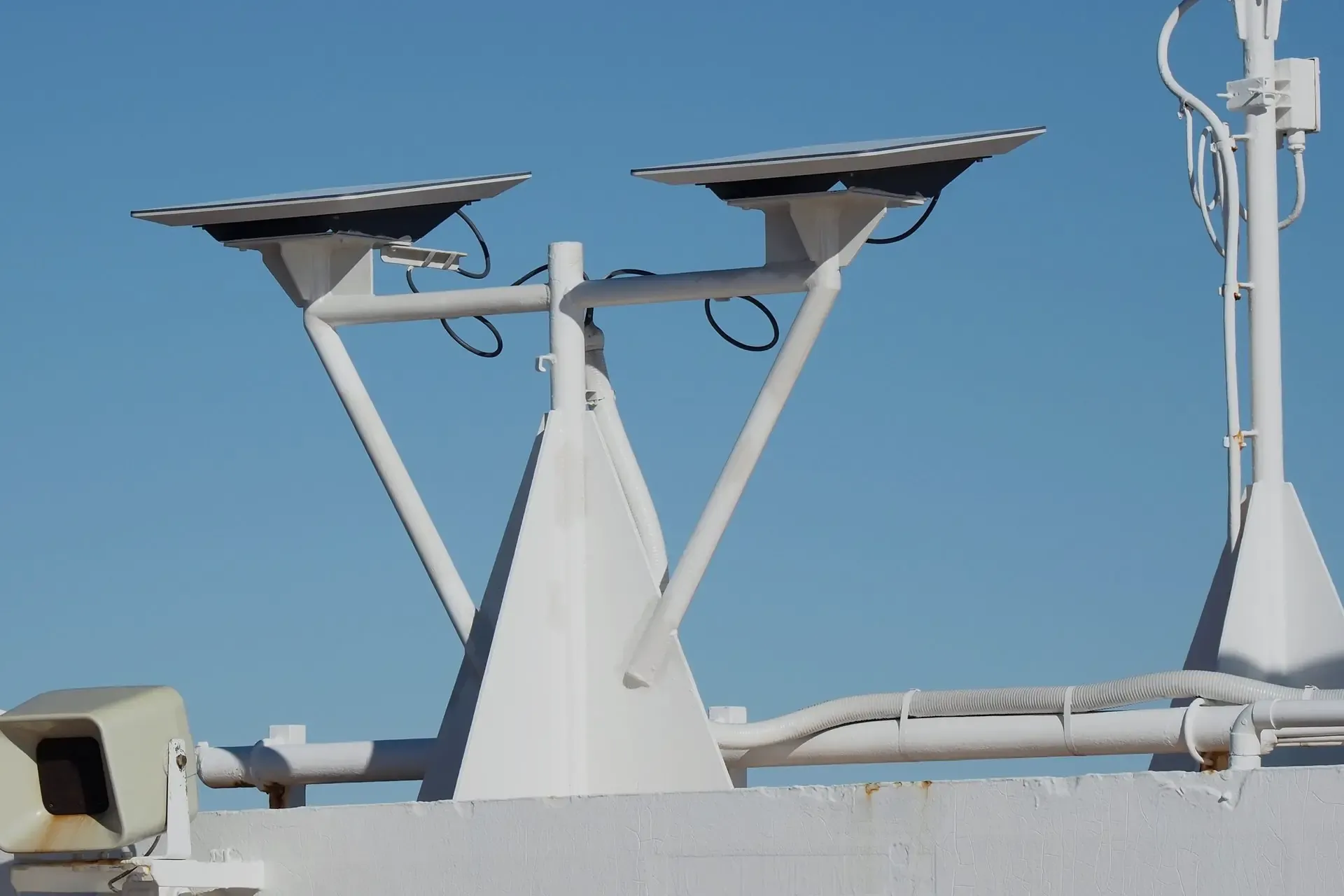
The maritime kit includes the Flat High Performance antenna, the Wi-Fi router, the deck cable and the base mount. What is worth knowing about the antenna:
- No moving parts. It is an electronically steered antenna that aims the link by itself while the boat moves. There is no motor and no radome to maintain.
- Size and weight. About 57 × 51 cm and around 3.5 kg, which allows mounting on a radar arch, a stern bracket or a mast platform without structural reinforcement.
- Power draw. Between 110 and 150 W in operation, more at start-up and in icing conditions. On a sailboat that forces a look at the power budget: it is the item that most surprises anyone coming from a 4G router.
- Rating. Designed for permanent outdoor use: salt, rain, vibration and spray. It is not a domestic terminal in a cover.
For small boats sailing close to the coast there is also the Mini terminal, portable and lower-powered, with less capacity and without the ruggedness of the Flat High Performance. It suits some inshore boats and tenders, not as the main terminal of a boat that genuinely goes to sea.
The installation: what it includes and what is decided first
The antenna is fitted by a certified communications-systems integrator that we appoint and coordinate from start to finish. What a professional installation includes:
- Choosing the location. The point with the clearest sky, away from the radar and without the mast, rigging or hard-top blocking the horizon. It is the decision that weighs most on performance, which is why it is made on a survey visit, not over the phone.
- Mounting bracket. Fabricated or adapted for that boat: radar arch, mast platform, stern bracket or deck base. On superyachts, recessed and with a matched cover.
- Cable run and power. With a watertight deck gland, chafe protection and power from the boat’s panel with its own breaker. On sailboats, the power budget is reviewed here.
- Onboard network. Router configuration, extra access points if needed and zone separation: bridge, crew and guests, each with its priority.
- Verification and handover. Speed and latency tests at the berth, obstruction check and a handover report with the results.
What is not included by default, and is quoted separately before work starts: integration with the chartplotter, AIS and the NMEA 2000 bus, connection to a VMS on fishing vessels, extending Wi-Fi across several decks and any additional electrical work. We cover it in detail in what a professional installation includes, in who can install Starlink Maritime and in warranty, support and SLA of the marine installer.
The cost: what it depends on
We do not publish prices, and it is not to hide anything: the terminal’s is set by the operator and changes; the installation’s depends on your boat; and the monthly fee depends on the plan. What can be explained is what each item depends on:
| Item | What moves it |
|---|---|
| Flat High Performance terminal | Nothing: the operator’s price, the same through every channel |
| Installation | Cable run, access to the arch and the panel, finish (exposed or recessed) |
| Monthly fee | The plan’s geographic scope and priority-data tier |
| Integrations | Chartplotter, AIS, NMEA 2000, VMS, extended Wi-Fi, second antenna |
The only negotiable item is the installation, and not by haggling but by scope: the simpler the mount, the shorter the working day. And the one that changes the annual sum most is pausing: if you sail five months, you pay five months. We have a guide on the cost items and what moves them, and the firm quote comes out of the preliminary analysis, which is free.
The management panel: what comes with the service
Every InternetenelMar customer gets the same management dashboard at no extra cost: as of September 2026 it has nine functions, limits included, and it is what turns an antenna into a line you can administer.
- Usage per boat and per device. What each boat in the fleet has used and, within it, which device or zone.
- Alerts before the invoice. Email alerts when usage reaches the percentages you choose, sent to whoever you decide.
- Contract pausing. In whole months, against the annual allowance, with the discount reflected on the next invoice.
- Bandwidth sharing. Speed per zone and fair sharing between users, so the bridge and telemetry are not starved because someone is streaming.
- Shared data pool. On fleets with a pool-type account, the monthly volume of all contracts is combined and one boat’s spare margin is used by another. The operator sets it up and maintains it.
- Cybersecurity. A firewall per vessel, a private tunnel to the operator’s systems and a network split into zones, with category and schedule filtering.
What the panel does not do today: automatic failover between the satellite and a 4G backup. Splitting traffic between links exists and is configured remotely; the automatic switch when one drops is not in production yet, and we would rather say so here than at the first fault.
By type of vessel
Sailboat or yacht of 10 to 15 metres. At that size the decision is the terminal: Flat High Performance if you sail beyond coastal waters or under way; the Mini only for coastal, occasional use, given its lower draw and capacity. The antenna goes on the stern arch or an unobstructed mast bracket, the cable enters through a sealed deck gland and power comes from the boat’s panel through the appropriate converter. InternetenelMar advises at no cost, does not install, and coordinates the installation with a certified integrator at the port you choose; the plan is chosen by area and sailing months and, on recurring plans, pauses in whole months for the lay-up (2026).
Sailboat and motor yacht. What decides the purchase is the power budget, an unobstructed location and a regional plan with lay-up pausing. MaritLink is our dedicated guide for this segment.
Superyacht and charter. Many simultaneous users, integration with onboard systems and, often, two terminals. Zone management in the panel and extended Wi-Fi are the parts that matter most. Start with Starlink on superyachts and Starlink for charter companies.
Fishing vessel. What matters is integration with the VMS and the electronic logbook, the ruggedness of the mount and a data plan for crews that spend weeks aboard. PescaSat is the guide for that segment, and here is the fleet overview.
Commercial and offshore vessel. Starlink as the main link for crew and operations, with VSAT or a second constellation as backup for critical operations. The comparison of every technology explains when each combination makes sense, and the communications regulations what is mandatory and what is not.
Frequently asked questions
Can I use the residential Starlink plan on my boat?
In port and in very coastal waters it works, but it is not designed to move or to go offshore: the operator can throttle or block it once the antenna moves away from the registered address, and the domestic terminal is not rated for permanent marine exposure. To sail you need a Maritime plan with the Flat High Performance terminal.
What speed and latency can I expect at sea?
Between 50 and 220 Mbps down and between 25 and 60 ms of latency, depending on area, plan and time of day. These are indicative figures published by the operator in 2026, not a guarantee: in crowded areas in high season speed drops, and on an ocean passage the link is usually steadier than near a saturated harbour.
Does it work with the boat moving and in rough seas?
Yes. The marine terminal is a flat, electronically steered antenna with no moving parts that tracks the satellites while the boat pitches and rolls. What does affect the link is obstruction: the mast, the rigging or a radar arch blocking the sky. That is why the antenna’s position is the first thing decided at installation.
Can I pause the service in the months I don't sail?
On recurring plans, yes. Pausing works in whole months, against an annual allowance of days, and starts at the beginning of a month: you plan the whole lay-up, not odd weeks. During the pause there is no monthly fee and the terminal remains yours.
Who does the installation and what does it include?
It is carried out by a certified communications-systems integrator that we appoint and coordinate. It includes the mounting bracket, the cable run to the interior, power from the boat’s panel, configuration of the onboard network and verification of the link before handover, with a test report. Integration with the chartplotter, AIS or management systems is quoted separately and always before work starts. On most vessel sizes, one working day (2026).
How much does Starlink cost for a boat?
It depends on three items: the terminal, whose price is set by the operator and is the same for everyone; the installation, which depends on the cable run and access to the panel and the arch; and the monthly fee, which rises in steps with priority data and the plan’s geographic scope. We do not publish prices because they change often and because installation depends on your boat: we put them in writing, at no cost, once we have seen where and how you sail.
How to sign up through InternetenelMar
- Tell us what boat you have, where it sails and how many people are aboard, in the contact form.
- We analyse the route, the possible antenna location and the plan that fits, and send you a written proposal. Free and without commitment.
- We coordinate the installation with a certified integrator at the port that suits you.
- The service is live on installation day, with the test report and access to the management panel.
We are a commercial agent: the operator sets the price of the terminal and the monthly fee, and the proposal reaches you in writing, with the three cost items, before you commit to anything.
Related guides
- Satellite internet at sea: every technology compared: Starlink, Amazon Leo, VSAT, Iridium, OneWeb and 4G side by side.
- Starlink Maritime: complete guide to coverage, plans and sign-up: the article this page grew out of.
- How much does Starlink cost for a boat: the items and what moves them.
- How to install Starlink on a sailboat: mast or deck mounting, power draw and cabling.
- Amazon Leo: what it is and what it means for sailors.